
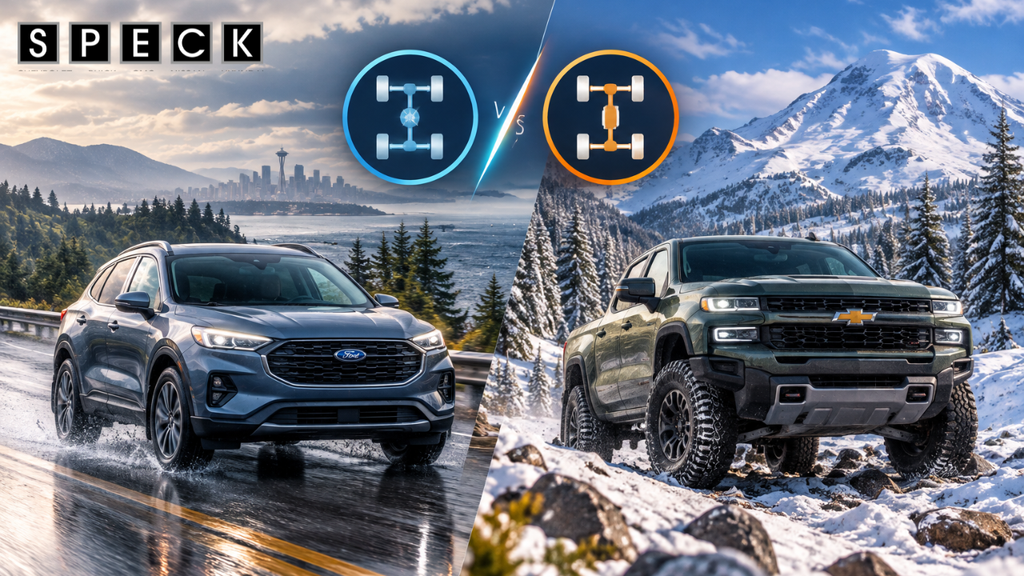
Quick Answer:
Choosing between AWD and 4WD for Washington roads depends on your driving conditions. AWD automatically distributes power to improve traction on wet pavement, light snow, and everyday highway driving. 4WD is generally better suited for deep snow, mud, rugged trails, agricultural work, and other demanding terrain.
Navigating the diverse geography of Washington State requires a vehicle capable of adapting to rapidly changing weather and road surfaces. From wet coastal highways and torrential rain in Western Washington to heavy mountain snowpacks and unpaved agricultural tracks in the Yakima Valley, maintaining traction is essential. For local car buyers, selecting the right drivetrain directly impacts vehicle safety, long-term maintenance costs, fuel economy, and driving confidence throughout the year.
Deciding on a drivetrain means weighing mechanical capability against your actual daily driving habits. While both systems send power to all four tires, they operate using distinct mechanical principles engineered for different challenges. This guide breaks down the core differences between all-wheel drive and four-wheel drive, helping you make an informed decision for Washington’s unpredictable climate and varied terrain.
Why This Matters for Washington Drivers
Washington presents some of the most dynamic driving conditions in the Pacific Northwest. Commuters frequently encounter standing rain on Interstate 5, sudden ice patches across Blewett Pass, or thick mud on orchard access roads throughout Central Washington. Driving a two-wheel-drive vehicle in these environments can lead to frustrating wheel slip, compromised stability, and safety hazards during sudden winter storms.
Choosing the proper configuration ensures your vehicle maintains traction when weather conditions deteriorate. Beyond immediate safety, your decision impacts long-term ownership costs, including tire wear, fuel economy, and resale value. Understanding these mechanical trade-offs allows local buyers to balance everyday comfort with raw off-road performance.
Understanding these mechanical trade-offs allows local buyers to balance everyday comfort with raw off-road performance when visiting our Speck dealership locations across Washington or shopping online.
Understanding the Difference: AWD vs. 4WD
How All-Wheel Drive (AWD) Works
All-wheel drive is an automated system designed primarily for on-road traction and handling. Modern AWD setups utilize electronic sensors, viscous couplings, or differential clutches to monitor wheel speed continuously. When the system detects a loss of grip on wet pavement or light snow, it automatically routes engine torque to the wheels with the most traction without requiring any driver input.
AWD operates continuously in either full-time or part-time on-demand configurations. Because it automatically adapts to changing road surfaces, AWD is exceptionally user-friendly for daily commutes, rain-soaked highways, and light gravel roads.
How Four-Wheel Drive (4WD) Works
Four-wheel drive, often referred to as 4×4, is a heavy-duty system engineered for rugged off-road terrain and severe low-traction environments. Traditional 4WD systems utilize a mechanical transfer case to split power evenly between the front and rear axles. Most 4WD vehicles require the driver to engage the system manually using a switch, button, or mechanical lever.
A key feature of true 4WD is low-range gearing (4-Lo). Low range multiplies engine torque at slow speeds, allowing heavy-duty trucks and SUVs to climb steep inclines, pull heavy equipment through deep mud, or crawl over unplowed mountain snow.
Best Options, Comparisons, and Recommendations
Daily Commuting and Highway Travel
For most drivers navigating city streets, suburban highways, and wet asphalt, all-wheel drive is the superior choice. The National Highway Traffic Safety Administration notes that four-wheel traction systems significantly reduce crash involvement during adverse weather conditions like snow and ice by maintaining vehicle momentum and directional stability.
- Best Suited For: Rainy commutes, light snow, wet mountain passes, and paved highways.
- Key Advantage: Operates automatically without driver intervention while delivering predictable, car-like handling.
Severe Off-Roading and Heavy Work
When your driving involves rough forest service roads, agricultural fields, or deep unplowed snowpacks, four-wheel drive is unmatched. Technical testing published in the SAE International Journal of Passenger Cars demonstrates that 4WD vehicles equipped with low-range gearing outperform AWD systems in extreme off-road obstacle clearance and sustained low-speed traction maintenance.
- Best Suited For: Deep mud, rock crawling, unpaved ranch trails, and heavy commercial towing.
- Key Advantage: Mechanical axle locking and low-range torque deliver maximum push through severe obstacles.
Key Features and Buying Considerations
Fuel Economy and Efficiency
Weight and mechanical drag play significant roles in overall fuel consumption. According to fuel efficiency estimates published on FuelEconomy.gov, choosing an AWD crossover typically reduces fuel economy by only 1 to 2 mpg compared to a front-wheel-drive equivalent. Conversely, heavy 4WD truck systems introduce additional kerb weight and driveline drag that can lower fuel efficiency further, particularly when engaged unnecessarily on dry pavement.
Vehicle Technology and Driver Input
Modern AWD vehicles feature sophisticated torque-vectoring technology that can send precise power increments to individual wheels during high-speed cornering. This seamless operation makes AWD ideal for drivers who prefer a hands-off safety net. In contrast, traditional part-time 4WD requires driver awareness; operating a locked 4WD system on dry, high-traction pavement can cause severe driveline binding and tire scrub.
Resale Value and Ownership Costs
Both configurations hold excellent resale value across the Pacific Northwest due to high consumer demand for all-weather capability. However, 4WD vehicles contain heavier transfer cases and solid axle components that may require specialized fluid changes and long-term mechanical attention. AWD systems rely heavily on electronic sensors and clutch packs, making routine tire rotations crucial to prevent system strain caused by uneven tread wear.
Common Mistakes to Avoid
A frequent mistake among drivers is assuming that AWD or 4WD helps a vehicle stop faster on snow or ice. While four-wheel traction aids acceleration and stability under power, it has zero impact on braking distance. Stopping capability depends entirely on tire grip, brake performance, and anti-lock braking systems.
Another common oversight is failing to match drivetrain capability with appropriate tires. Equipping an advanced AWD or 4WD vehicle with worn highway tires severely diminishes its winter performance. Investing in severe-service mountain-snowflake-rated winter tires or high-traction all-weather tires ensures your drivetrain delivers its maximum mechanical advantage.
Expert Tips for Buyers
- Evaluate Your Actual Route: Choose AWD if 90% of your driving consists of paved highways, rainy commutes, and maintained mountain passes; select 4WD if you regularly face unplowed roads, deep mud, or heavy trailering.
- Rotate Tires Regularly: Keep tire tread depth uniform across all four wheels on AWD models to avoid damaging sensitive electronic differentials.
- Disengage 4WD on Dry Pavement: Always return part-time 4WD systems to 2WD mode when returning to dry asphalt to prevent mechanical wear and axle binding.
- Verify Towing Limits and Payment Structures: Check manufacturer gross combined weight ratings before choosing a vehicle for hauling campers or agricultural trailers, and explore loan options at our Speck auto finance center.
- Review Available Inventory & Incentives: Save on your next AWD crossover or 4WD work truck by checking our latest new vehicle specials.
Frequently Asked Questions
Is AWD or 4WD better for driving in Washington snow?
For plowed roads and slushy mountain passes, AWD is generally better because it reacts automatically to changing road grip. For deep, unplowed snow or steep rural driveways, 4WD with low-range gearing provides superior low-speed pulling power.
Can you leave 4WD on all the time?
No, you should not leave part-time 4WD engaged on dry or paved roads. Locking the front and rear axles together on high-traction surfaces causes driveline binding, severe tire wear, and potential transfer case damage.
Does AWD cost more to maintain than 4WD?
Maintenance costs are generally comparable, but they differ in focus. AWD systems require strict adherence to tire rotation schedules to maintain equal tire circumference, while 4WD systems require periodic transfer case and differential fluid service.
Can I trade in my 2WD vehicle for an AWD or 4WD model?
Yes, you can easily appraise your current trade-in vehicle online and apply its value toward an all-wheel drive or four-wheel drive upgrade. Visit our contact our dealership team page to schedule an appraisal and test drive.
Neither system improves gas mileage. In fact, sending power to all four wheels adds weight and mechanical resistance, slightly reducing fuel economy compared to two-wheel-drive vehicles.
Will AWD or 4WD improve my gas mileage?
Final Thoughts
Choosing between AWD and 4WD depends on where and how you drive in Washington State. AWD is a practical choice for daily highway commutes. It also provides added traction in rain and light snow. In contrast, 4WD is better suited for more demanding conditions.It can handle rough trails, deep mud, and heavy towing. As a result, outdoor enthusiasts and commercial operators may benefit more from 4WD. Consider the road conditions you face most often. This can help you choose a safe and reliable vehicle. For more winter driving tips, explore our Speck Motors dealership news articles. You can also learn more about our regional programs on the Speck community involvement page.
Ready to find your next vehicle? Visit Speck Dealerships in Yakima or Tri-Cities today — or browse our inventory online.
For a visual comparison of how these drivetrains perform when handling icy highway passes and snowy mountain routes, this AWD vs 4WD Winter Driving Guide demonstrates how power distribution functions in real-world winter conditions.
